
The decision this guide helps you make
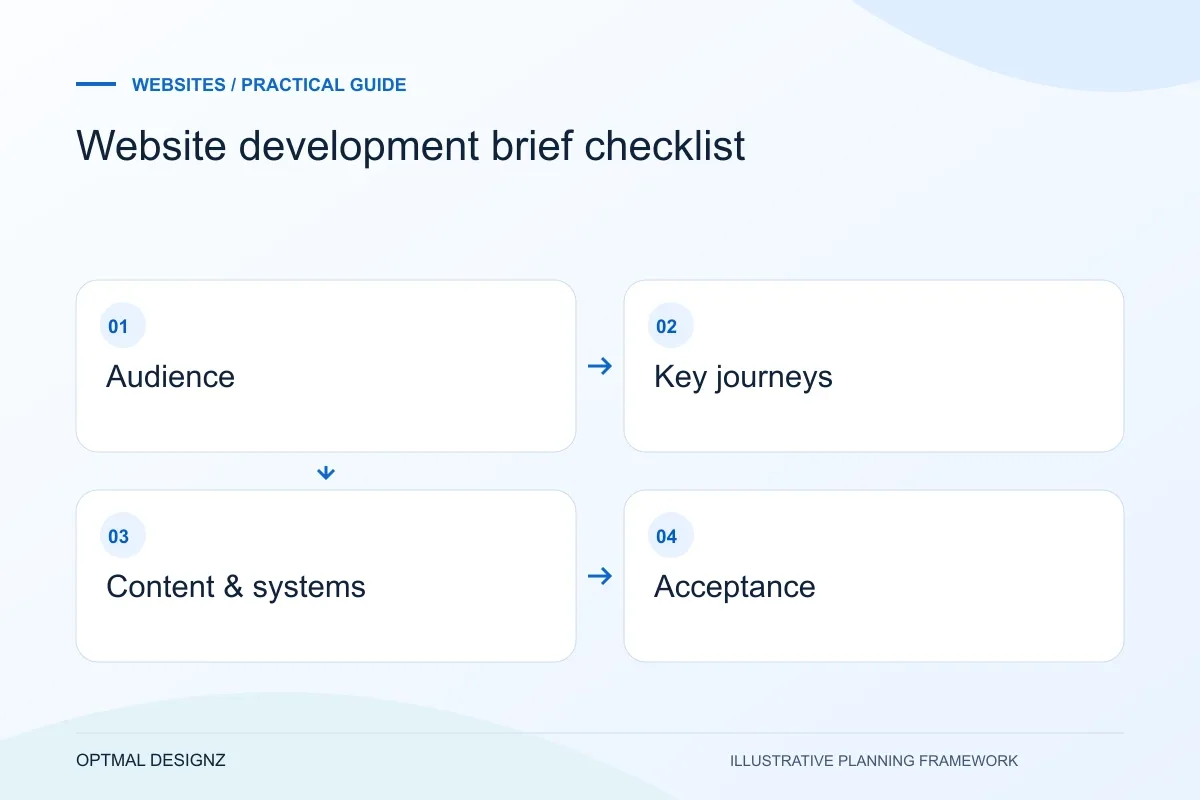
A website development brief explains who the site serves, what visitors should be able to do, the pages and content required, and the connections and responsibilities involved. A useful brief lets suppliers estimate the same scope rather than quote for different assumptions.
Build a useful website brief covering audiences, journeys, content, integrations, responsibilities and the evidence needed to accept the finished site.
List the must-complete visitor tasks, content owner, editing roles, existing URLs and external systems. Ask each supplier to identify assumptions and exclusions against that same list.
A practical example to test the choice
Compare a five-page information site with a site that also needs staff editing, a booking connection and migration of existing search-visible pages. The number of pages alone does not describe the difference in work.
This is an illustrative planning scenario, not a claim about a completed client project. Use your own records and operating rules to confirm whether the approach fits.
Begin with the job the website must do
A brief is most useful when it describes what a visitor needs to achieve. Identify the main audiences, why they arrive and the action that would represent a successful visit. A prospect comparing services has different questions from an existing customer looking for support. Describe those differences before specifying a page count or visual style.
Separate business objectives from website functions. More qualified enquiries is an objective; an enquiry form is one possible function. Record what makes an enquiry useful, who receives it and what happens next. That gives a supplier a better basis for proposing a journey than a request for a modern website alone.
Define the Saudi customer journey before the page list
A Saudi business website should make the next customer task clear: compare a service, find a product, request a quotation or complete an order. A Riyadh professional-services firm and a Jeddah trade supplier need different information and enquiry paths. Use accurate service coverage and genuine examples rather than adding near-identical city pages.
Where customers need Arabic and English, plan translation, right-to-left layouts, paired navigation and editorial ownership together. For online selling, confirm SAR presentation, address fields, delivery coverage and the interfaces supported by the actual merchant and logistics accounts.
Show the content and systems already involved
List current pages, brand materials, product records and photography, including what can be reused and what needs preparation. Name the person who will approve copy and the person who will edit the site after launch. Content preparation is work that needs an owner and a place in the schedule.
For bookings, payments, CRM or email connections, describe the required hand-off. Include the platform names and whether access is available, but do not send passwords in an initial brief. A connection should be investigated before it is treated as an included, fixed-cost feature.
Make priorities and acceptance visible
Split requirements into essential first-release journeys and later options. Explain any deadline and its reason, such as replacing an unsupported site or supporting a planned launch. Ask suppliers to identify assumptions, exclusions and decisions that could change cost or timing.
Define acceptance in terms of tasks: a mobile visitor can find a service, submit a valid enquiry and receive confirmation; an editor can change opening information without breaking the layout. These are proposed checks to agree with the supplier, rather than a promise that a particular platform includes every capability.
Request a scope-and-responsibility sheet
Ask for a short document connecting each essential visitor task to its page or feature, content owner and acceptance check. Add an assumptions column for items such as third-party access or content that has not been supplied. This makes a missing dependency visible before it becomes an unexplained delay. Review the same sheet when a request changes: does it replace an existing requirement, expand the release or belong to a later phase? The sheet should be understandable to the person approving the budget as well as the delivery team.
| Area | Decision to record |
|---|---|
| Enquiry journey | Destination, success condition and business owner |
| Content | Who prepares, reviews and approves it |
| External connection | Access dependency and feasibility check |
Worked example: a planning exercise
Hypothetical example: a consultancy wants enquiries from two buyer groups. Its brief names one service journey for each group, five reusable page types, an existing mailbox and one editor. Online booking is recorded as a later option. Suppliers can now price the same first release and explain the extra work if booking becomes necessary, instead of quoting incompatible interpretations of a ten-page website.
Your practical checklist
Use these checks to turn the discussion into decisions that can be assigned, tested and reviewed.
- Name the main audiences and their most important tasks.
- Supply the current URL and an inventory of useful content.
- Identify content preparation, approval and editing owners.
- List external systems and the precise information hand-off.
- Separate first-release requirements from optional later work.
- Agree task-based launch checks and the support boundary.
Apply the checklist to your Saudi project
For a Saudi brief, define which customer tasks need Arabic, English or both, including right-to-left navigation, dates and form confirmations. Confirm genuine service coverage and, for commerce, the selected payment, delivery and finance interfaces.
Use the example above to discuss website development brief checklist with the people who will use or approve the result. Ask a supplier to demonstrate the expected output, explain a failure case and identify what is excluded from the proposal.
Related services and next steps
Sources and further reading
Check source guidance directly, especially where platform details or requirements can change.