
Make the proposals comparable before scoring them
A ten-page brochure site and a ten-page site with booking, account access and CRM routing are not equivalent purchases. Ask each supplier to respond to one brief describing your audiences, the actions visitors need to complete and the systems involved. Name the content you already have and the parts that need writing, photography, translation or migration.
Treat an unspecified item as an open question, not a free inclusion. If a proposal says contact form, ask where the message goes, how delivery failures are shown, whether spam controls are included and how successful receipt is tested. A quotation is more valuable when its assumptions are visible than when every feature has a confident tick beside it.
Use a weighted scorecard, not an unstructured impression
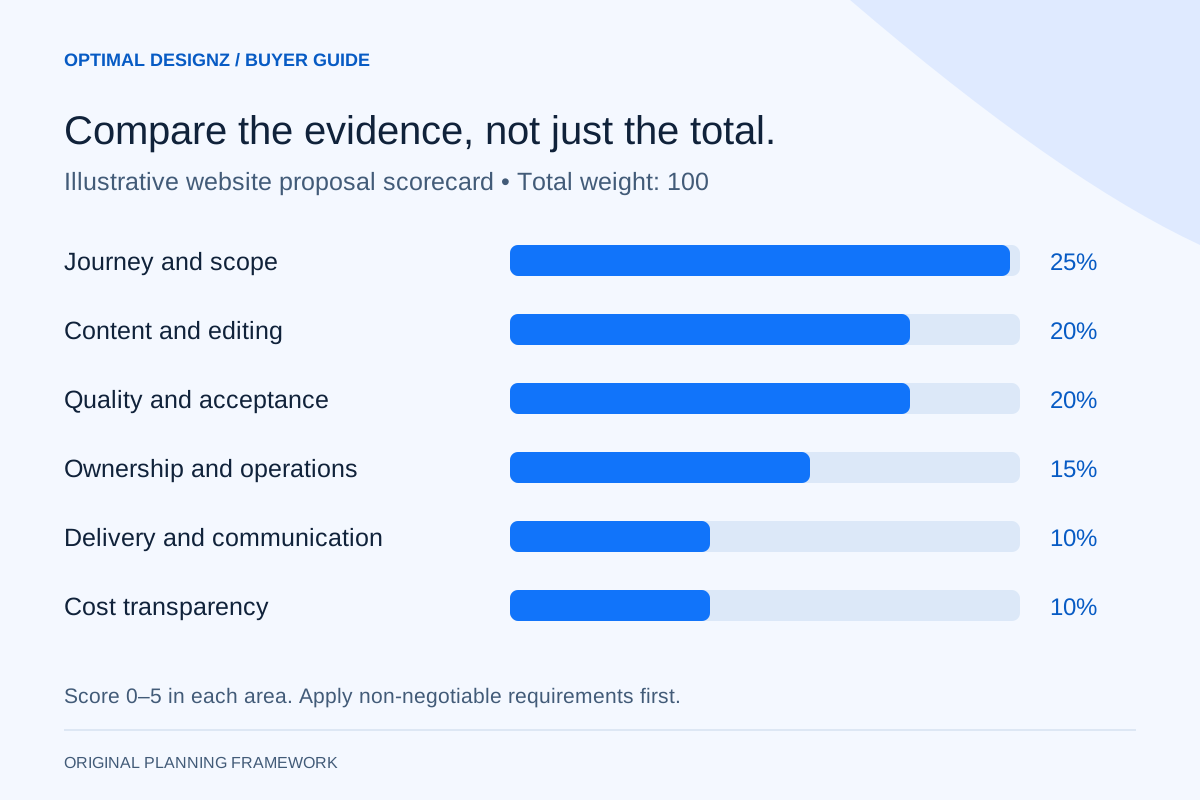
The following weights are an illustrative buying tool, not a research-backed universal ranking. Adjust them before reading the proposals: an ecommerce business may need more weight on checkout and stock connections, while an editorial site may prioritise publishing. Score each area from zero to five using written evidence and demonstrations.
For each area, calculate score ÷ 5 × weight, then add the results for a total out of 100. Set non-negotiable requirements separately. A high total should not compensate for a supplier being unable to deliver a necessary booking integration or unwilling to put account ownership in writing.
| Area and weight | Evidence to request | A warning sign |
|---|---|---|
| Journey and scope fit — 25 | Page types, user tasks and integration boundaries | Only a page count or attractive homepage |
| Content and editing — 20 | Content responsibilities and a CMS editing demonstration | Content included with no deliverable definition |
| Quality and acceptance — 20 | Mobile, accessibility, performance and form test plan | A perfect score promised without test conditions |
| Ownership and operations — 15 | Account access, licences, backups and handover | Critical accounts held only in the supplier's name |
| Delivery and communication — 10 | Milestones, dependencies and change control | A launch date without review responsibilities |
| Cost transparency — 10 | One-off, recurring and optional costs separately | An unexplained total and unspecified renewals |
Check content and CMS responsibilities in a live demonstration
Ask to see someone change an ordinary service page, update an image, edit navigation and preview the mobile result. Check whether these tasks require development, a licence or a maintenance plan. The point is not to demand unlimited editing of every design detail; it is to understand which routine changes your team can make safely.
Agree the content inventory and approval workflow. Who writes the service explanations? Who confirms business claims? Who supplies image licences and alt text? If an old site is being replaced, specify which content is moved, rewritten or retired and who approves the redirect map. A content delay can hold up a site even when the templates are finished.
Specify acceptance checks that reflect real visitors
Write a short list of tasks: a mobile visitor finds the right service, understands coverage, submits an enquiry and receives an accurate confirmation. Test keyboard navigation, visible focus, form labels, error messages and useful image descriptions. W3C's Easy Checks are a starting review, not proof of complete accessibility conformance; a supplier should explain the depth and limits of its evaluation.
Performance commitments need a device, page sample, test conditions and a distinction between lab results and real-user data. A single excellent homepage test does not establish the speed of every page or every visitor's connection. If Core Web Vitals are in scope, ask how field measurements will be reviewed once enough data exists. Do not turn a Lighthouse target into a guarantee of rankings or enquiries.
Compare costs over the same operating period
Separate design and build, content preparation, migration, third-party setup and launch from hosting, licences, support and later changes. Use a common comparison period such as 24 months. Include your internal review time and any known migration or training costs, but avoid hiding uncertain work inside a precise total.
For illustration only, Proposal A might be £4,000 to build plus £150 a month for hosting and support: £7,600 over 24 months. Proposal B might be £5,500 plus £60 a month: £6,940. These invented inputs are not market prices or Optimal Designz quotes. They also do not establish that B is better: editing limits, support coverage and excluded content could reverse the comparison. Compare equivalent inclusions and record what remains uncertain.
Ask who owns the site and who can recover it
Confirm who controls the domain, hosting, CMS administrator account, analytics property and any payment or booking accounts. Ask what code, content, licences and documentation you receive and what rights depend on third-party terms. Put the arrangement in the project agreement rather than assuming that payment automatically transfers every dependency.
Ask for a backup and restoration process, update responsibilities, monitoring and a route to export content if the supplier relationship ends. Recovery should be tested against a practical scenario: the form stops delivering messages or an update breaks a page. A named response process is more useful than an undefined promise of lifetime support.
A shortlist demonstration that reveals more than a portfolio
Give each shortlisted supplier the same small demonstration task. Ask them to walk through a comparable service journey, explain how a message reaches the business and show how an editor changes a page. Use authorised sample information; do not share customer records or passwords just to obtain a quote.
Request an example of an exception, such as a failed form submission or a missing product field. Discuss how they would test the issue and who would fix it after launch. Existing work can show design judgement, but a portfolio screenshot alone does not demonstrate your proposed functionality, ownership terms or support arrangements.
- Confirm the complete journey and its exclusions in writing.
- List the accounts and content each party must provide.
- Agree review milestones and how scope changes are authorised.
- Document launch tests, redirects, handover and post-launch support.
Questions buyers often ask
Should I always choose a custom website? No. A well-configured existing platform may meet the brief with simpler editing and support. Custom development is justified by the required experience, integration or workflow rather than by the word bespoke in a proposal.
Can a web agency guarantee SEO results? A supplier can commit to defined technical work, content deliverables and measurement. It cannot control search-engine rankings or guarantee a particular number of enquiries. Ask what will be checked and reported rather than accepting a ranking promise.
What if the cheapest proposal is missing detail? Ask for a revised scope against the same brief before rejecting or accepting it. The goal is to identify the real difference, not to assume that either a higher price or a lower price proves quality.
Comparing proposals for an Oman website
Specify genuine delivery, appointment or service coverage for Muscat and other locations. If commerce or booking is required, include OMR display and calculation requirements, confirmation messages and the actual supported payment or scheduling provider. Ask for a full Arabic journey where it is required, including right-to-left layouts and reviewed translations.
Request costs in OMR with clear renewal and support terms. The worked GBP comparison is only an explanation of the calculation. Give each supplier the same source content, data and provider assumptions so the apparent price difference reflects a comparable delivery scope.
Related services and next steps
Sources and further reading
Check source guidance directly, especially where platform details or requirements can change.