
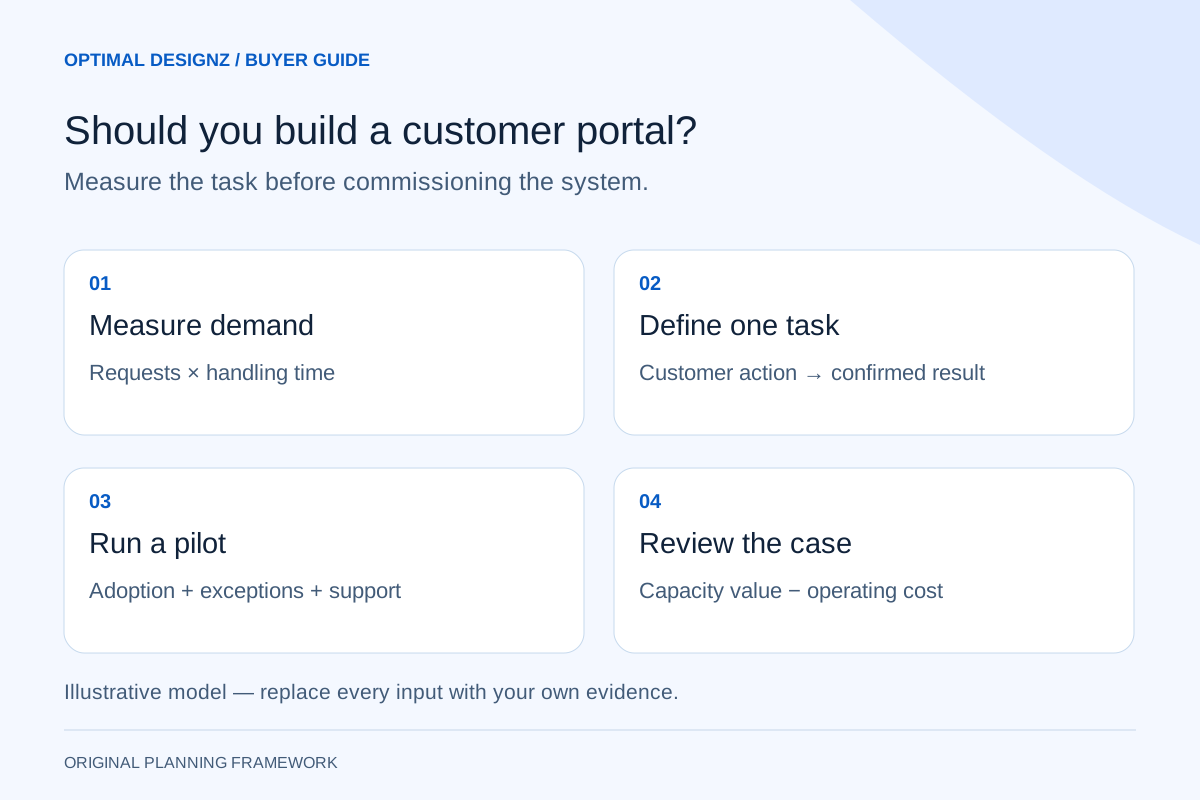
What a customer portal actually does
A customer portal is a secure area where a customer can see or act on information associated with their organisation or account. Examples include checking order progress, downloading an approved document, accepting a quotation or submitting a service request. The portal usually presents information from another business system; it does not automatically replace that system.
The useful question is not how many features a portal could have. It is which recurring task a customer can complete without asking a member of staff, and what happens after they complete it. If a quotation acceptance still has to be retyped into the sales system, the portal may simply move the administrative queue.
Find a task with enough repeat demand
Review a representative sample of emails, calls and support requests. Classify the requests by task, record how often they occur and measure the staff time needed to resolve them. Include searching for a record, checking access, replying and correcting errors. Separate a routine status request from a complaint that needs judgement.
Interview customers about the moment they need the information. A buyer may prefer an email link for a monthly document but a portal for daily order tracking. A request for self-service is useful evidence; an internal assumption that every customer wants another account is not. Existing account features, better notifications or a clearer document process may solve the problem at lower cost.
| Observed problem | Smaller option to test first | When a portal may help |
|---|---|---|
| Customers ask when an order will arrive | Reliable status notifications | Customers need several live orders and related actions |
| Staff resend the same approved documents | Secure document delivery with expiry controls | Customers need a permission-controlled document history |
| Quote decisions arrive in inconsistent emails | A controlled approval link | Buyers manage multiple quotes, approvers and revisions |
| Customers cannot explain a fault clearly | A structured request form | They also need case history and progress updates |
A worked model: time recovered is not cash saved
The following figures are hypothetical, not Optimal Designz prices or client results. Suppose a team receives 300 routine status requests each month and each takes eight minutes to handle. That is 40 hours of current handling time. If 60% of those requests move to a portal, the gross time avoided is 24 hours. If portal exceptions and account support take six hours, the net time recovered is 18 hours per month.
At an assumed loaded staff cost of £25 per hour, those 18 hours represent £450 of capacity value. If hosting, licences and support cost an assumed £180 per month, the illustrative net operating benefit is £270 per month. For an assumed £9,000 initial investment, simple payback would be about 33 months. The figures are calculation inputs only, not an estimate for your project.
This model excludes financing, discounting and any separately valued commercial effects. Recovered capacity becomes a cash saving only if spending actually falls. Otherwise, identify the productive work the team will do with those hours. Run the same model at lower adoption and higher support cost: if only 30% of requests move online, gross time avoided falls to 12 hours. After the same six hours of support, capacity value is £150 and the assumed operating cost is not covered.
- Monthly handling hours = request count × minutes per request ÷ 60.
- Net hours recovered = handling hours avoided − new exception and support hours.
- Monthly operating benefit = value of recovered capacity − recurring portal costs.
- Simple payback = initial investment ÷ positive monthly operating benefit; it is not meaningful when the monthly benefit is zero or negative.
Choose one complete first-release journey
For a quotation portal, a complete first release could let an invited buyer view the current approved quote, see its expiry date, accept it and receive confirmation that the sales system recorded the decision. Define what happens if the quote changes while the buyer is reviewing it. A screen saying accepted is not sufficient if the source system rejected the update.
Keep unrelated payments, marketing dashboards and full product catalogues out of the pilot unless they are necessary for that task. Ask the supplier to list the exact records, user roles, external interfaces and exception states included. Where the source system has no supported interface, investigate access and vendor restrictions before committing to the portal design.
Test permissions and recovery before inviting customers
A buyer must not access another customer's records by changing an address or identifier. Test access on the server for every protected operation, not just by hiding buttons. Agree who can invite a colleague, revoke access and approve an important change. Include expired invitations, leavers, shared email addresses and customers associated with more than one organisation.
Simulate a delayed source system, a repeated submission and a partially completed action. Agree whether the customer sees pending, failed or completed and who investigates each state. Microsoft’s retry guidance explains that repeating an operation can have unintended effects unless the operation is designed to tolerate repetition. For a business buyer, the acceptance question is whether a double click creates one authorised decision or two conflicting records.
Measure a pilot against the original workflow
Invite a small representative group and define the pilot length and decision date in advance. Measure successful task completion, repeat contacts about the same task, support time, adoption and customer feedback. An invitation count is not an adoption measure; a login is not a completed order enquiry.
GOV.UK’s Service Manual recommends combining performance measures with user research rather than relying on digital analytics alone. Applied here, that means checking the portal's recorded completion against the actual outcome and asking customers where they got stuck. The manual describes public-service practice; it is a useful measurement reference, not a mandatory reporting rule for your private business.
- Define the task start and its source-system-confirmed end.
- Exclude staff tests from the customer completion measure.
- Record exceptions and new support work, not only successful sessions.
- Compare the pilot with the same task before launch, noting volume or staffing changes.
What should a portal proposal include?
Request a named first-release journey, the permission model, the source of each record, integration assumptions and an acceptance plan. It should also explain migration, account onboarding, accessibility, monitoring, ownership and how customers get help when the portal is unavailable. Separate delivery costs from recurring operation and later enhancements.
You do not need a complete technical specification to begin. Bring a sample of repeated requests, the current systems and the decisions customers should be allowed to make. Those inputs make the development discussion much more useful than a feature list copied from an unrelated portal.
Common questions before commissioning a portal
Can we keep our CRM or order system? Often the intended approach is to retain the system that owns the records and add controlled customer access. Feasibility depends on its supported interfaces, permissions, identifiers and vendor terms; it should be established before a fixed integration promise.
How much will a portal cost? The important variables are the customer task, authentication, roles, source-system access, migration, exception handling and support. The worked example above is not a quote. A proposal should price the agreed scope and expose the assumptions that could change it.
Should we build or buy? Evaluate an existing platform against the same task and permission tests. Bespoke development becomes a stronger option when supported configuration cannot complete a necessary workflow at an acceptable lifecycle cost. It is not automatically the best choice because a custom design looks more distinctive.
A Saudi pilot: delegated buyers and bilingual decisions
Test whether an invited buyer is authorised for one Saudi business entity or several branches. For a customer purchasing across Riyadh, Jeddah or other genuine service locations, define who can accept a quotation and which version they approve. Include Arabic/English notices, right-to-left screens and source-system confirmations when those journeys are required.
Use SAR costs and measured local workflow volumes in the model rather than presenting a currency conversion of the GBP example as a quote. Specify hosting, account access and review responsibilities. Where an operation affects finance or regulated information, obtain the responsible specialist's approval before including it in customer self-service.
Related services and next steps
Sources and further reading
Check source guidance directly, especially where platform details or requirements can change.