
The decision this guide helps you make
A POS pilot tests a complete checkout and back-office workflow in a controlled part of the operation before a wider rollout. It should include service conditions, staff permissions, devices, payments and reconciliation.
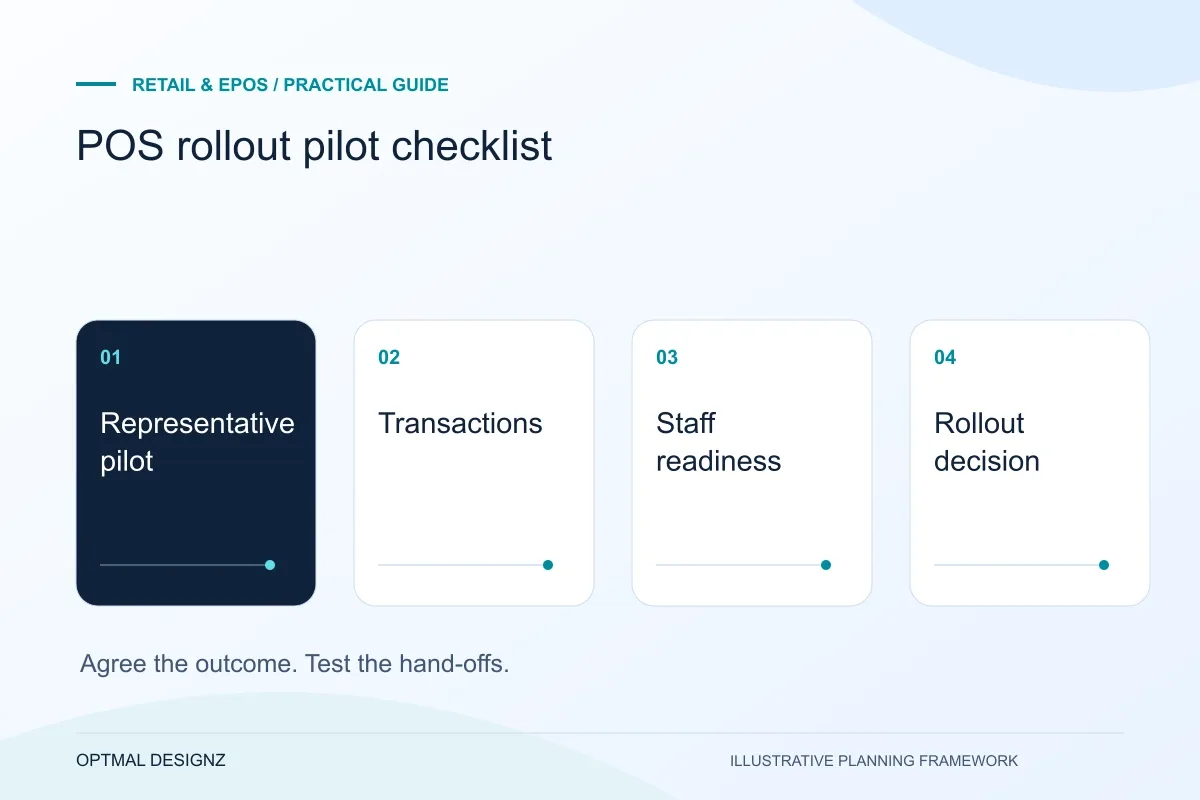
Use a representative counter or branch to validate hardware, payments, stock, staff access and recovery before expanding a POS rollout.
Choose the pilot location, acceptance cases, support owner and recovery plan. Broaden rollout only after the team can operate and reconcile the agreed workflows.
A practical example to test the choice
A test sale on a quiet desk does not show whether staff can handle an amended basket and a return during a busy shift. A useful pilot includes those representative tasks.
This is an illustrative planning scenario, not a claim about a completed client project. Use your own records and operating rules to confirm whether the approach fits.
Choose a pilot that exercises the important rules
Select a counter, location or controlled operating period that reflects the business’s genuine requirements. The easiest branch may omit the peripherals, variants or exceptions that make the rollout risky. Identify what the pilot needs to demonstrate before choosing its size or duration.
Document the intended configuration, including platform, devices, payment provider, product records and user roles. Official supplier migration and troubleshooting guidance can help identify product-specific dependencies, but the acceptance criteria need to reflect the actual operation.
Test beyond the straightforward sale
Include scanning, discounts, returns, partial payments where supported, stock adjustments and an end-of-day close. Test the intended connections to stock or accounting and check the resulting records. Staff should know how an incomplete payment or failed transfer is recognised and escalated.
Use authorised test arrangements and representative data. Avoid introducing live customer charges merely to exercise a feature without an agreed procedure. Record each result and the owner of unresolved issues so a polished demonstration does not conceal an operational blocker.
Agree a go, pause or recover decision
Before changing the remaining tills, define which failures prevent rollout and who can approve the next stage. Confirm staff guidance, opening records, recovery arrangements and supplier availability during the change. A pilot is a decision point, not a ceremony that automatically authorises expansion.
After expansion, compare transaction and stock records across locations and review staff questions. Keep the verified configuration and lessons from the pilot available to the rollout team. If a later branch differs materially, test those differences rather than assuming the first result covers every environment.
Agree a rollout decision log
List the scenarios the pilot must demonstrate and the evidence needed for a go decision. Assign issues to an owner and distinguish blockers from later improvements. Record the intended configuration and any difference introduced by the next location. Keep the recovery action and decision maker visible to the rollout team. This log helps prevent enthusiasm for a successful ordinary sale from overruling an unresolved refund, stock or closing problem that matters during normal operation.
| Decision | Evidence required |
|---|---|
| Go | Essential transactions and records meet acceptance checks |
| Pause | An important result is unresolved or unsupported |
| Recover | A critical live workflow cannot operate as agreed |
Worked example: a planning exercise
Hypothetical example: a pilot branch has ordinary retail sales, but a second branch also fulfils online collection orders. The first pilot does not prove the collection workflow. The rollout team adds tests for reserving, collecting and cancelling those orders before changing the second location.
Your practical checklist
Use these checks to turn the discussion into decisions that can be assigned, tested and reviewed.
- Choose a pilot that represents the important operating conditions.
- Record the exact platform, hardware and role configuration.
- Test sales, exceptions, stock and closing procedures.
- Track results and assign unresolved issues to named owners.
- Agree go, pause and recovery criteria before expansion.
- Retest meaningful differences at later locations.
Apply the checklist to your UK project
Use the actual UK store, provider account and device models. Follow a sale, return and reconciliation through every affected system rather than relying on a generic till demonstration.
Use the example above to discuss pos rollout pilot checklist with the people who will use or approve the result. Ask a supplier to demonstrate the expected output, explain a failure case and identify what is excluded from the proposal.
Related services and next steps
Sources and further reading
Check source guidance directly, especially where platform details or requirements can change.