
The decision this guide helps you make
A first software release should complete a useful business task from start to finish. Choose the smallest coherent workflow that users can operate and accept, rather than a collection of unfinished screens.
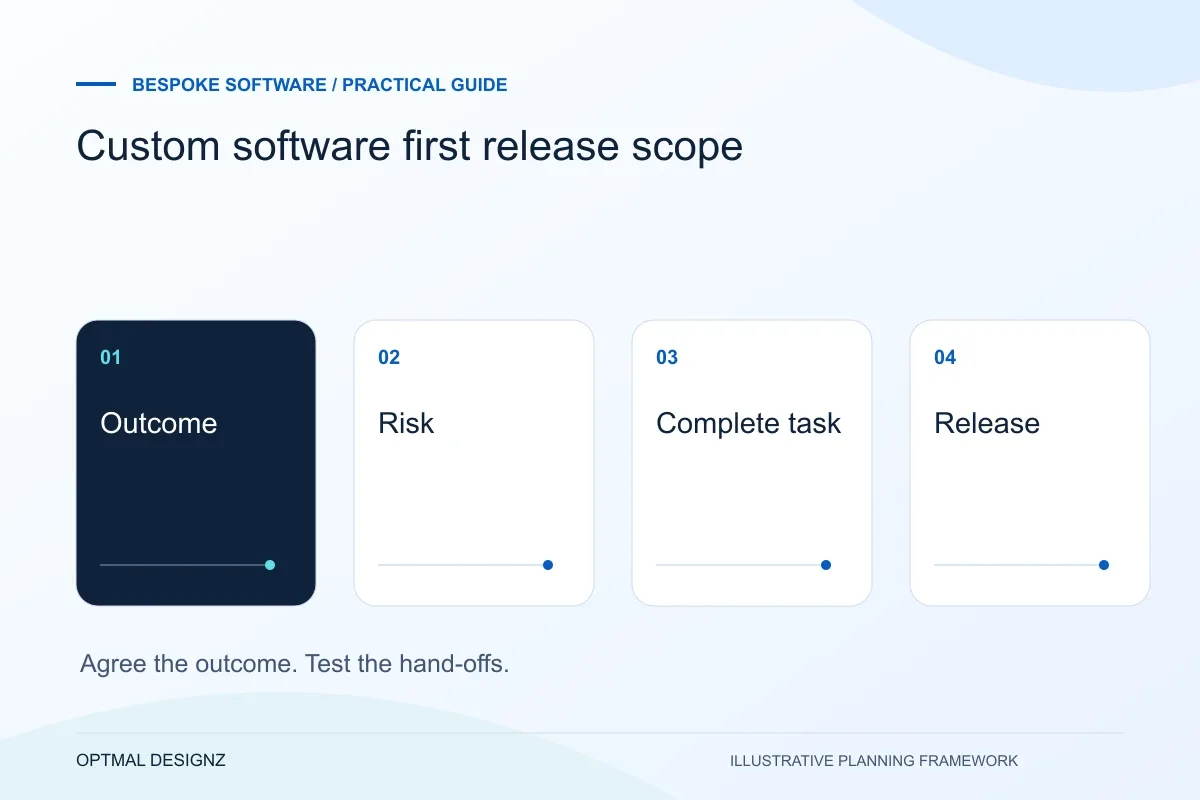
Choose a complete business outcome, test the riskiest assumptions and separate a production first release from a disposable prototype.
Define users, inputs, permitted actions, outputs and exception cases. Separate essential completion steps from features that can be added after real use.
A practical example to test the choice
A request can be submitted, reviewed and resolved with an audit trail. Advanced analytics may wait; a required approval or failure message cannot be omitted if the task depends on it.
This is an illustrative planning scenario, not a claim about a completed client project. Use your own records and operating rules to confirm whether the approach fits.
Pick an outcome rather than a small number of screens
A first release should let a defined group complete something useful. Five unfinished modules can provide less value than one complete order-approval workflow. Name the user, starting information, required decision and evidence that the task finished successfully.
Separate necessities from convenient additions. Ask what would prevent the workflow from operating without a feature, and whether an agreed manual step is a sensible temporary alternative. Record the trade-off so a later stakeholder does not assume that an omitted feature was simply forgotten.
Resolve the assumptions that could change the approach
An uncertain integration, a complex approval rule or an untested customer journey may need investigation before production scope is fixed. A prototype can answer a targeted question without implementing the full system. GOV.UK’s alpha guidance discusses using prototypes to test risky assumptions; it is guidance for government services, not a fixed schedule for every private project.
Make the prototype’s status explicit. Code built to explore an idea may not have the controls, reliability or operating arrangements required for production. Do not quietly turn a demonstration into a live business dependency because the interface looks complete.
Include acceptance and operations in the first phase
A small production release still needs appropriate permissions, validation, deployment and recovery arrangements. Agree the sample tasks and exceptions that demonstrate acceptance, plus any data migration and user guidance. Those responsibilities do not disappear because the release is called an MVP.
Define how feedback will be gathered and what would justify expanding the scope. Compare actual use and unresolved problems with the original objective. A later phase should follow the evidence and remaining priorities, not a predetermined list of features that has never been tested with users.
Use a release boundary sheet
Document the initial users, trigger, completed outcome and the capabilities deliberately deferred. Include any temporary manual steps with their owner and review date. Add the risks that need investigation before production work and the acceptance examples for the finished release. When a new feature is proposed, assess whether it changes the defined outcome or belongs in the next stage. The sheet keeps a focused first release distinct from both a prototype and an indefinite promise to deliver every future idea.
| Scope item | Decision to make |
|---|---|
| Essential workflow | What can the initial users complete? |
| Temporary manual step | Who operates it and when will it be reviewed? |
| Later capability | What evidence would justify adding it? |
Worked example: a planning exercise
Hypothetical example: a maintenance business wants scheduling, invoicing and customer accounts. Its first release covers assigning a job, recording completion and making overdue work visible. Invoicing remains in an established platform for now. A prototype first tests mobile completion on site, while the production phase includes access rules, validation and handover.
Your practical checklist
Use these checks to turn the discussion into decisions that can be assigned, tested and reviewed.
- Name one useful end-to-end outcome and its initial users.
- List blockers separately from later improvements.
- Investigate the assumptions that could change feasibility.
- Label prototypes and production deliverables distinctly.
- Include acceptance, access, recovery and user guidance.
- Agree the evidence needed to prioritise the next phase.
Apply the checklist to your UK project
Use one actual UK team workflow, including the staff who approve changes and the systems they can access. Distinguish implementation from hosting, licences and ongoing support.
Use the example above to discuss custom software first release scope with the people who will use or approve the result. Ask a supplier to demonstrate the expected output, explain a failure case and identify what is excluded from the proposal.
Related services and next steps
Sources and further reading
Check source guidance directly, especially where platform details or requirements can change.